
Profit-booking by participants in view of the domestic markets' recent record-setting run fuelled the downtrend

Besides being an investment instrument, it is hedge against inflation and store of value.

BRICS countries may reach consensus at next month's G20 summit on creating a $100 billion currency reserve fund to help ease short-term liquidity pressure and safeguard financial stability of major emerging economies, a senior Chinese central bank official said.
Profit taking was seen in financials and index heavyweight Reliance Industries after recent gains.

The rupee depreciated 39 paise to an all-time low of 82.69 against the US dollar in early trade on Monday as elevated crude oil prices and risk-averse sentiment among investors weighed on the local unit. Moreover, a negative trend in domestic equities and firm American currency sapped investor appetite, forex traders said. At the interbank foreign exchange, the rupee opened at 82.68 against the greenback, then slipped further to 82.69, registering a fall of 39 paise over its previous close.

The RBI refuses to classify a cryptocurrency as an asset since it doesn't have future cash flow and its value is always fluctuating because of speculation. There is also no consumer protection, observes Tamal Bandyopadhyay, and hence the e-rupee trial run.

The markets had touched their highest levels in a month.
Domestic woes of high trade and fiscal deficits, high inflation, low confidence, lack of will for reforms, were adding to the fall of the rupee.

'To simply let the rupee depreciate to any level according to market forces will not be in the country's interests.'
The rupee depreciated 7 paise to an all-time low of 80.05 against the US dollar in early trade on Tuesday tracking the strength of the American currency and firm crude oil prices. At the interbank foreign exchange, the rupee opened at 80 against the American dollar, then lost ground to quote at 80.05, registering a fall of 7 paise from the last close. In initial trade, the local unit also touched 79.90 against the American currency.

The 50-issue NSE Nifty tumbled 91.80 points, or 0.92 per cent, to close 9,872.60

India will soon meet Iraq and the United Arab Emirates (UAE) to seek a definitive rate of discount on crude oil similar to what Russia has provided so far, sources said. Multiple officials and industry executives said Iraq, which is India's biggest oil supplier, wants to discuss the level of discounts expected by Indian refiners. India's focus on snapping up ever-increasing volumes of Russian crude oil has led to a corresponding decline in imports from the Middle East. Flows from Iraq, Saudi Arabia, and the UAE have suffered as a result.

The fall in total reserves was mainly because of a decline in foreign currency assets worth $4.5 billion, the data showed.
Investors are willing to wait to give a new government a chance.
Analysts are predicting that in the next one month or so, the rupee may touch 46 against the US currency, an expectation reflected in the trends in the newly-launched currency futures market. The Indian currency will be at 46.32 after 12 months, data from the NSE currency futures market showed.

Indian government bonds, particularly those of shorter maturity, strengthened sharply on Monday, as the collapse of the California-based Silicon Valley Bank (SVB) prompted investors to rush to the safety of American debt, leading to a decline in US bond yields.
The immediate challenge to faster growth is to restore stability to the currency markets.

Experts believe there are more such decisions in the offing, which along with a recovery in economic growth and India Inc.
The rupee depreciated 31 paise to an all-time low of 80.15 against the US dollar in early trade on Monday tracking the strength of the American currency and firm crude oil prices. At the interbank foreign exchange, the rupee opened at 80.10 against the dollar, then lost ground to quote at 80.15, registering a fall of 31 paise from the last close. On Friday, the rupee closed at 79.84 against the dollar.

IndusInd Bank was the biggest loser in the Sensex pack, shedding 7.46 per cent, followed by SBI, Tata Motors, M&M, Bajaj Finserv, Axis Bank and Infosys. In contrast, Tech Mahindra was the only winner.

Brent crude prices fell to $57 a barrel on Monday from $62 a barrel.
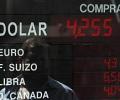
Defuses worries on global currency war.

US Fed rate rise raises risk of further drying up of FII flows.
Further outperformance hinges on pickup in industrial activity, buying by local investors.

'Overall, the Indian economy is doing well.' 'Our economic fundamentals are strong and the early signs of recovery are sustainable.' 'This is positive for the market in the long run.'

As we say shalom to 2016, the key drivers for the markets in the year ahead have become more obvious, says Neeraj Gambhir, managing director and head of fixed income, India, Nomura. First, there is a surging dollar. Second, rising commodity prices. Then, we have the effects of demonetisation.

The ballooning of crude prices has significantly increased the country's oil import bill and it can also lead to a worsening of the current account deficit and fiscal deficit for the domestic economy.
